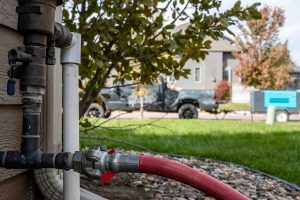
Hi, if you’re not planning to winterize, your irrigation system this year, just please do one thing, make sure that your backflow preventer or vacuum breaker is taken care of. It’s the most expensive part of your system. And it’s also the most susceptible to freeze damage, largely in part because a lot of times they’re above ground. So make sure you take care of this. And I’m going to show you real quick how to do it because it’s super easy.
So I’ll get you over here to where you can see. And what we’re going to do here is one, make sure that your main valve is turned off. And when you turn off the main valve, oftentimes, you’ll see water drain out of here. That’s okay, that’s normal. That’s what you want, you want the pressure relieved, and you want the water gone. So you’ll see water come out. And that’s a good thing. The next thing is to go to your ball valves. And you want to turn them on a 45. Now, if they’re like this parallel, that means it’s on. If it’s perpendicular like that, that means it’s off, and you definitely don’t want them off, because a lot of times water will sit in there and your ball valves will freeze and you don’t want that. So what we like to do is put them on a 45 and set them right there. And then the next thing you want to do is get a flathead screwdriver, just a typical flathead screwdriver, and then open up your ports. And if you’re not sure if you’ve got your port open or closed, you can actually look in there and you can see the little ball valve in there and make sure that it is open. This one has two of them. There’s one here, there’s one on the back. I’ll do that one later because you can’t see it anyway. Just make sure those open sometimes there’s four of them in a line. Just make sure they’re all open, and you’re good to go.
This is a very important part. What it does is prevents water from back flowing into the city’s water system and contaminating it from the irrigation system. So you want to make sure that you take good care of this part. So that’s it. That’s all I wanted to share with you. If you have secondary water, you don’t need to worry about this part. Secondary water systems don’t have it. But if you have culinary water, you should have this part. So that’s it for today. Let us know if you have any questions or need any help. We’ll be happy to help it’s 801-540-4713 or tuxedo yard care.com. We’ll see you later. Bye.